Meet the Makers: An Early Christmas Shopping List from the Colony of Artists

Updated: Sep 24

AI illustration for the4pegs.com, in our So Scottish palette.
Every September, a quiet corner of Abbeyhill turns itself into one of Edinburgh's loveliest open secrets. For one weekend, the Colony of Artists throws open the doors of homes, gardens and hidden nooks across the Abbeyhill Colonies, and more than 135 artists across over 60 venues invite the public in to see, and buy, work made a few steps from where it hangs.
The setting is as much a part of the story as the art. The Abbeyhill Colonies are rows of stone terraces stacked like a colony of bees — hence the name, and the beehive emblem the festival still uses. Each front door opens off its own outside stair, with a small garden behind, which was almost unheard of for working families in Victorian Edinburgh — and those same gardens and forestairs are what make wandering between studios on festival weekend feel more like visiting friends than browsing a market.
This year's festival ran on 19 and 20 September 2026, and I came home with a fistful of business cards rather than any real Christmas shopping done. Roughly, what's on offer splits into two camps: Edinburgh and nature illustration you can pick up as an affordable print or original card, and small studio makers — glass, ceramics, clocks, textiles — selling one-off pieces. So consider this your very early gift list, sourced directly from the people who made the things, and from what caught my eye on the day.
Clarabunda — for the only night skies at the whole festival
Clare Bevis draws Edinburgh's buildings in a bright, energetic style, mixing digital art with gouache. Smaller original cards and prints are there too, at a properly gift-friendly price.

The real thing: an Edinburgh sunrise in the same colours as Clarabunda’s collection. Photo: Sharon McMenemy Khan.
Sharon's local tip: Clarabunda was the only place I saw night skies — that sort of evening, purply-pinky Edinburgh palette. If you like that, there's some really nice stuff there.
Potterly Studios — for the host who actually uses their kitchen
Edinburgh-based ceramicist trained in Chinese and Korean pottery techniques, throwing functional pieces on the wheel.

AI illustration for the4pegs.com — the giant green serving plate from Potterly’s collection, above an old-fashioned kitchen hob.
Sharon's local tip: You can get bowls that hold your chopsticks, and they're just really nice things to give as a Christmas gift. A lot of the pottery looked really great — they had a great centrepiece, so if you do a lot of serving and have people over for dinner, there are pieces that could be used as platters, which are big. Alternatively, if you've got that really horrible backsplash to your kitchen hob and you're looking for something to take up that space and look great, there are pottery pieces you could probably order that would do that.
Emily Gait Illustration — for the calendar that's actually worth hanging up
Watercolour and pen sketchbook illustrations of Scottish streets, harbours and hillsides, sold as prints and in her own 2027 Sketchbook Series calendar.

Emily Gait with her illustrated 2027 calendar. Photo: Sharon McMenemy Khan.
Sharon's local tip: The card I can't stop thinking about is the bothy — an old-fashioned cottage with a picnic table, a snowman and two bicycles resting against the wall. It's such a sweet, childlike embrace of cycling and local life, and as a cyclist myself I fell for it completely. There's a lovely winter parklife scene too. If you have outdoorsy friends, these are the sweetest cards — so pretty they're almost frameable; I'd honestly get a mat board and frame one.
Not everything in Emily's calendar is Edinburgh, but showing up at the Colony of Artists says everything about her love for what goes on in the city. And there's a pegs connection: Sharon cycled the John Muir Way herself and photographed it for her 2023 exhibition. Emily's bicycles and Sharon's photographs are the same joy — Scotland seen from a saddle — caught in a beautiful winter scene that, the way winters are going, might be worth holding onto.
Nutmeg Glass — my favourite find of the day
Leith-based glassmaker Meg McGregor hand-blows contemporary glassware inspired by the natural world — vases, jugs, candleholders, baubles and more.
Sharon's local tip: The icicles have been part of my Christmas theming for years now. The first year we put a small real tree in the downstairs hallway for everyone to enjoy — twenty or thirty monochrome baubles, easy to decorate, absolutely lovely. After a couple of years we wanted a change, and a tree hung with Meg's icicles fitted in beautifully. A few polar bears underneath and you have a whole winter scene — and it's just lovely to open the door and there it is. It all lives in our vestibule, which is a shared space, and that's my real recommendation: Edinburgh is full of communal hallways and stairwells, and something this simple is the sweetest way to share the holiday spirit with your neighbours.

The hand-blown icicles in the Peg Gallery's festive window on St Mary's Street — each one made individually by the artist. Photo: Sharon McMenemy Khan.
It's a display that's become a little landmark of its own, and the idea travels: the same bare-branch-and-glass winter look turns up in Fringe set design — venues like Glob have run with it. Which is the quietly brilliant thing about shopping local — an idea born in a shop window on one Edinburgh street can end up on a world stage.
Adriana de Matos Artwork — for the wildlife or Scottie-dog lover
Portrait and wildlife illustration with a Scottish accent — red squirrels, wrens and ravens, plus a soft spot for Scottie dogs. Adriana moved to Scotland and has been illustrating its creatures ever since.
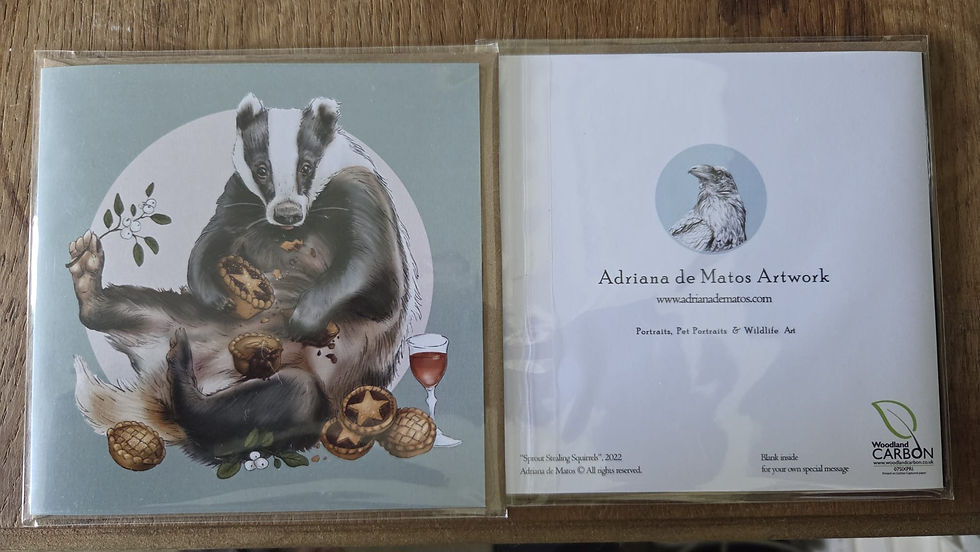
Adriana's “Sprout Stealing Squirrels” card — my favourite Christmas card of the festival. Photo: Sharon McMenemy Khan.
Sharon's local tip: Adriana's Christmas cards are absolutely adorable — humorous and quirky, sometimes a little naughty, and every British person you know will chuckle at them. If you have UK relatives living abroad, send them one in the Christmas post. And just look at her badger: mince pies, a glass of red and a sprig of white-berried mistletoe — the whole of Christmas in one card. It's exactly the season to make something with mincemeat, and the trick is frangipane: mincemeat on its own can be a bit blah, but a frangipane mincemeat tart — that almond-based treat — is totally delicious. You can pick up mincemeat at the Iceland at the top of Easter Road. Add mulled wine, mince pies and a great sense of humour, and you've got the loveliest little package to send someone and bring Christmas cheer into their life.
Contact: adrianadematosart@gmail.com
Ellen Martin Textile Designer — for genuinely special taste
Ellen Martin was the standout discovery of the festival for me — the first time I'd seen her work, and I haven't stopped thinking about it since. Is this the designer about to break out of the Scottish craft scene and into the zeitgeist? She's Edinburgh-based and Glasgow School of Art-trained, working in printed and dyed silk, and her design language spans cultures: she travelled to Japan to immerse herself in printmaking techniques, and you can feel that precision in everything from her silk scarves to the exclusive furoshiki wrapping cloths she designed for V&A Dundee.
What drew me most were her pink lava prints. 'Lava' in old Scottish usage is seaweed — not molten rock — a plant that grows in the sea, and it comes in different colours. The pink variety Ellen works from occurs naturally in the rockpools at the Scottish Seabird Centre in North Berwick, and I've picked up that exact seaweed myself on that same shore. When a designer's starting point is something you've held in your own hand on the beach, the collection feels like it was made for you.

Foraged seaweed from the rockpools at the Scottish Seabird Centre, North Berwick — 'lava' in the old Scottish sense, and the very thing that inspired Ellen's pink lava prints. Photo: Sharon McMenemy Khan.
Sharon's local tip: A piece by her is a thing everyone will still be talking about around the Christmas tree for years from now, and everyone will want something from her collection. If you can get it now, honestly, I think you should.
Colinton Clocks and Homewares — for an older relative with impeccable taste
Ian Graham hand-builds wooden gear clocks and mechanisms in Colinton — old-fashioned, made-to-order and properly handcrafted. He also runs Mesmerising Mechanisms, a free hands-on exhibition of his wooden machines.

AI illustration for the4pegs.com — clockwork carved from Scottish nature: thistle gears, oak-leaf spokes, a rowan-berry pendulum.
Sharon's local tip: Super sweet, kind of old-fashioned, made to order and handcrafted. If you've got an older relative and you want to give something that fits their aesthetic, they'd probably absolutely love it.
Contact: Ian Graham, 07762 203576, iangraham737@gmail.com
These are just my seven favourite finds of the weekend — there were plenty of other well-known names showing across the 60-odd venues too. Colony of Artists runs the third weekend of September each year, so it's worth putting straight in next year's diary, whether you're a host pointing guests towards something genuinely local to do on a Scottish city break, or just after Christmas presents with a story attached. In the meantime, browse a few more Scottish makers and prints over at our own So Scottish shop.
From lockouts to lockdowns: why the pegs love the colonies
The stonemasons who built these streets weren't locked out for long. In 1861 they pooled what they had and founded the Edinburgh Co-operative Building Company, and from 1867 its members paid in week by week to build what working Edinburgh had never had before: a front door of their own, up an outside stair, with a garden behind it. Walk the lanes on festival weekend and the beehive emblem finally makes complete sense — this was collective graft, quite literally building a community out of trades and trust.
It's also why the 4 pegs feel so at home here. Our name comes from a clothes peg: the St Mary's Street laundry that survived lockdown while the street level above it became the Peg Gallery, our gallery, workspace and podcasting place. The peg stands for the everyday work that never stops — the washing, the tidying, the small unglamorous jobs whose everyday efforts make visitors' stays — and it's the part of our story we're proudest of. The masons refused to stay locked out; the laundry refused to stay locked down. Different centuries, same city, same belief: ordinary effort, kept at, makes something that lasts.
Which makes this my favourite photo from the weekend — a colony garden in full September bloom, washing out on the line, the front door waiting at the top of its stair. A hundred and fifty years on, the gardens are still doing their job. The pegs are still holding.

A colony garden on festival weekend — front stair, sunflowers and the washing out on the line. Photo: Sharon McMenemy Khan.



Comments